Click or Drag-n-Drop
You can drop your own file here
Bria FIBO 1.5: JSON-Native Text-to-Image Model
What is Bria FIBO 1.5?
Bria FIBO 1.5 is a text-to-image model that turns a short prompt into a rich, structured JSON prompt and then renders a photorealistic image from it. Built on an 8B-parameter DiT, flow-matching architecture and trained exclusively on licensed data, FIBO is designed for controllable, predictable, and commercially safe generation. Every request returns both the final image and the structured_prompt JSON it was built from, so you can inspect, refine, or recreate any result. That combination of photorealism and auditable control makes FIBO a strong fit for production and agentic image pipelines.
Key Features
- JSON-native prompting: short prompts are expanded into structured captions up to 1,000+ words describing lighting, camera, composition, color, and depth of field.
- Disentangled control: adjust a single attribute — camera angle, lighting, skin tone — without breaking the rest of the scene.
- Three workflows: Generate from text, Inspire from a reference image, or Refine from a structured prompt plus a short instruction.
- Flexible output: 1MP or 4MP resolution, nine aspect ratios, PNG or JPEG, and deterministic seeds.
- Enterprise-safe: trained on 100% licensed data for governance and legal clarity.
Best Use Cases
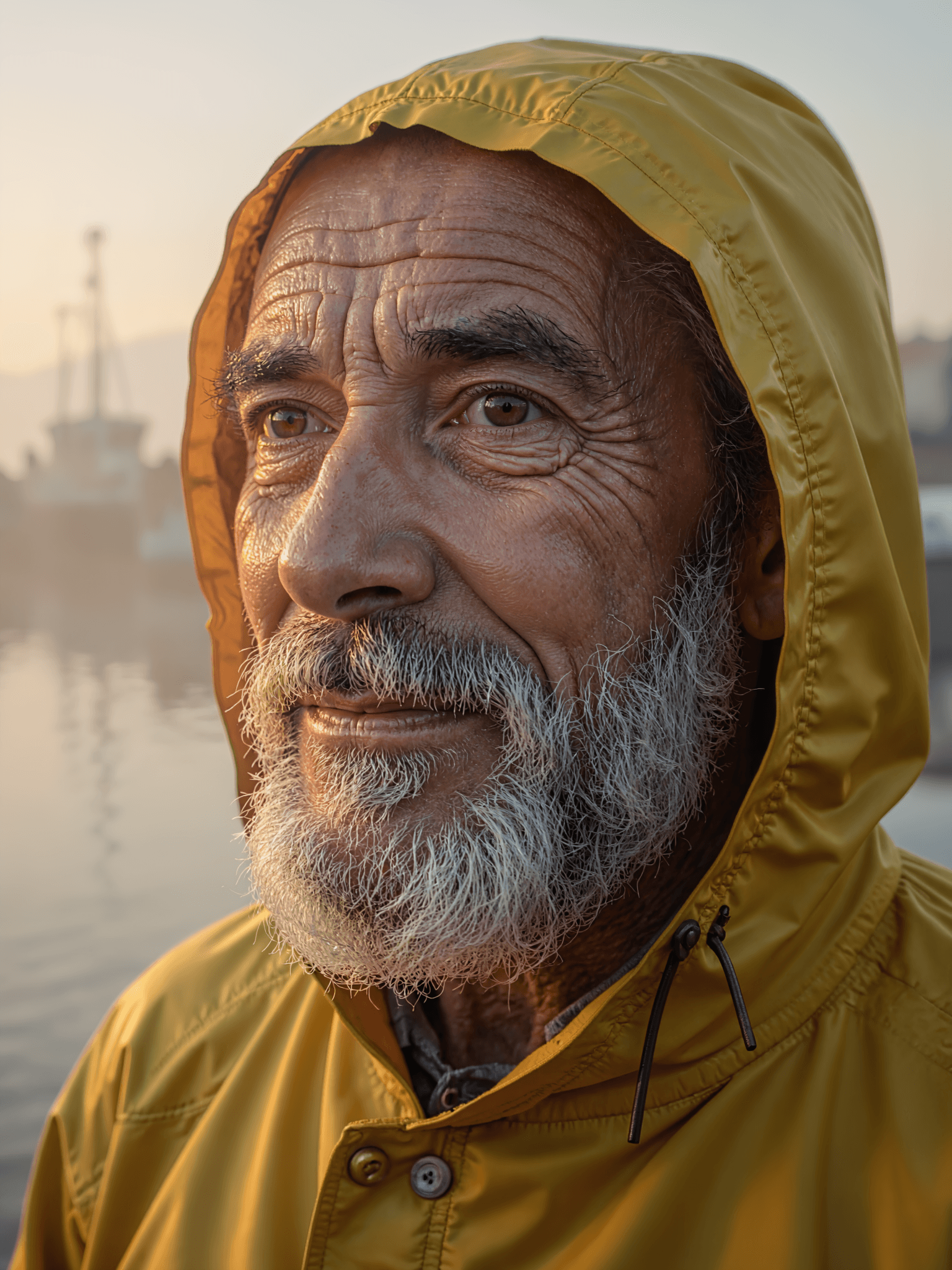
- Photorealistic portraits and product shots — in testing, a close-up fisherman portrait at 4MP rendered crisp skin texture, individual beard strands, sharp catchlights, and clean background bokeh.
- Reproducible brand and campaign assets, where a fixed seed plus structured prompt must recreate an image exactly.
- Agentic and automated pipelines that need programmatic, auditable control over every visual attribute.
- Iterative refinement, adjusting cues like "backlit" or "85mm" without rewriting the whole prompt.
Prompt Tips and Output Quality
Write natural, descriptive prompts covering subject, lighting, camera, and mood; FIBO fills in the rest. Choose 4MP for maximum photoreal detail (adds roughly 30 seconds) and 3:4 or 4:5 aspect ratios for portraits. Keep a fixed seed alongside the returned structured prompt to reproduce a shot or fine-tune one attribute at a time. For a reference-guided look, pass a single image instead of, or alongside, your prompt.
FAQs
Does FIBO return the prompt it used? Yes — every response includes the full structured_prompt JSON.
Can I use a reference image? Yes, pass a single JPEG, PNG, or WEBP to inspire generation. It cannot be combined with a structured prompt.
What resolutions are supported? 1MP for speed and 4MP for high detail.
Which aspect ratios are available? 1:1, 2:3, 3:2, 3:4, 4:3, 4:5, 5:4, 9:16, and 16:9.
Is FIBO commercially safe? It is trained exclusively on licensed data for rights-clear, enterprise-grade use.
Popular Models